Disability Insurance: Meaning, Benefits, Types, Coverage and How to Choose the Right Policy
Learn what disability insurance is, how it works, its types, benefits, eligibility, exclusions, and how to choose the right disability insurance policy in India.
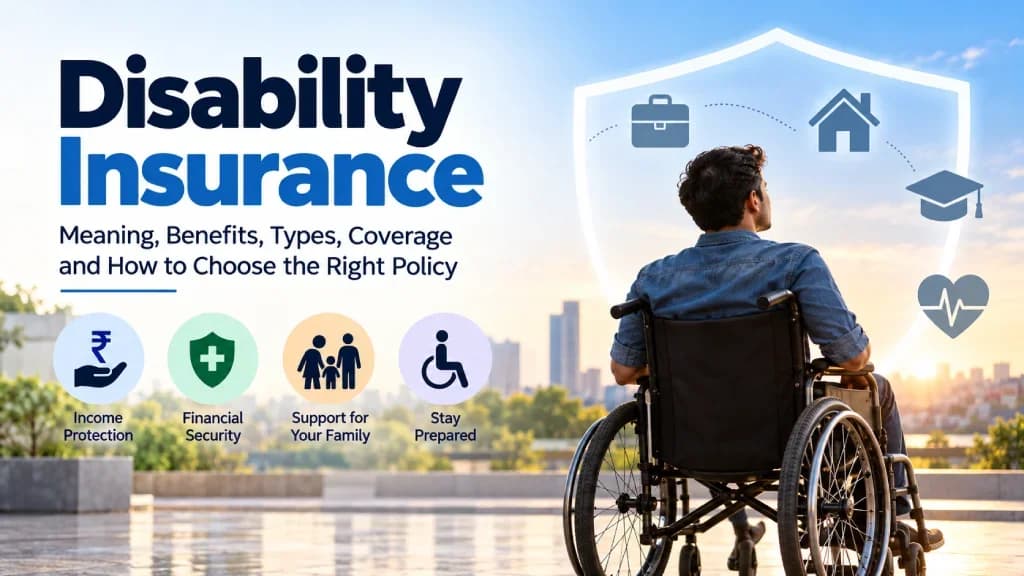
Life is unpredictable, and an unexpected accident or serious illness can change a person's ability to work and earn an income. While many people focus on health insurance and life insurance, they may overlook another important aspect of financial protection: disability insurance.
Disability insurance helps protect individuals financially when a covered disability prevents them from working or reduces their ability to earn an income. Depending on the policy, it may provide a lump-sum payment, periodic income benefits, or other specified financial assistance.
For salaried employees, self-employed professionals, business owners, and people who depend on their monthly income to meet household expenses, understanding disability insurance can be an important step toward better financial planning.
In this guide, we will explain what disability insurance is, how it works, the different types of coverage, its benefits and limitations, and what to consider before choosing a policy in India.
What Is Disability Insurance?
Disability insurance is a type of insurance designed to provide financial protection when a person experiences a qualifying disability due to an accident, illness, or another covered event.
Depending on the policy, the insurer may pay a fixed amount or a benefit based on the insured person's income, disability classification, or policy terms.
For example, imagine that a software engineer earns ₹80,000 per month. Following a serious accident, the engineer becomes unable to perform their regular job for an extended period.
Even if medical expenses are covered by health insurance, the engineer may still need money for rent, household bills, loan repayments, and family responsibilities.
A disability insurance policy with suitable income protection may help replace some of the lost earnings, subject to its eligibility requirements, waiting period, benefit limits, and exclusions.
The primary purpose of disability insurance is to reduce the financial impact of a covered disability. It does not necessarily cover every disability or replace the individual's entire income.
How Does Disability Insurance Work?
Disability insurance generally works through the following steps:
- Choose a policy: The individual selects a policy based on their occupation, financial needs, available benefits, and eligibility.
- Pay the premium: The insured pays the required premium according to the policy schedule.
- Experience a covered disability: An accident, illness, or other qualifying event affects the insured person's ability to work or meets the policy's disability definition.
- Submit a claim: The insured or their representative provides the claim form, medical records, and other required documentation.
- Insurer evaluates the claim: The insurance company checks the policy conditions, medical evidence, waiting period, exclusions, and disability criteria.
- Benefits are paid if approved: The insurer pays the applicable benefit according to the policy terms.
The amount and duration of benefits depend on the specific policy. Some policies provide a lump sum for specified disability categories, while others provide regular income payments when the insured meets the relevant conditions.
Types of Disability Insurance
Disability insurance policies can provide different kinds of protection. The following categories explain common coverage structures.
1. Short-Term Disability Insurance
Short-term disability insurance is designed to provide benefits for a limited period when a covered disability temporarily prevents an individual from working.
Depending on the policy, benefits may be payable for weeks or months, subject to the maximum benefit period.
Example: An employee suffers an injury and cannot perform their regular duties for several weeks. If the policy covers the condition and all claim requirements are met, the employee may receive temporary income benefits.
This type of coverage may be useful for people who have limited paid medical leave or insufficient savings to manage a temporary loss of earnings.
2. Long-Term Disability Insurance
Long-term disability insurance is intended to provide financial support when a covered disability continues for an extended period.
The benefit period varies by policy. Some plans provide benefits for a specified number of years, while others may provide them until a stated age, subject to the terms and ongoing eligibility requirements.
Example: A professional develops a serious medical condition that prevents them from carrying out their occupation for an extended period. A qualifying long-term disability policy may provide periodic benefits according to its terms.
Long-term disability coverage can be especially relevant for people whose households depend heavily on their future earning capacity.
3. Permanent Disability Insurance
Permanent disability coverage generally relates to a disability classified as permanent under the applicable policy.
Depending on the product, the policy may provide a lump sum for a specified permanent disability, such as the loss of a limb or loss of a defined bodily function.
Some policies distinguish between partial and total permanent disability.
The exact definitions, benefit percentages, medical evidence requirements, and exclusions must be checked in the policy wording.
4. Temporary Disability Coverage
Temporary disability benefits are designed for qualifying disabilities that are not classified as permanent.
Coverage may be included in personal accident insurance or another insurance product. The benefit may be a fixed weekly amount, periodic income replacement, or another specified payment.
Temporary disability coverage should not automatically be treated as equivalent to comprehensive short-term disability income insurance. The scope depends on the product and its terms.
5. Partial Disability Coverage
Partial disability coverage may apply when a person retains some ability to work but experiences a qualifying reduction in their work capacity or earnings.
For instance, an injury may prevent a technician from performing certain physical tasks while allowing them to continue working in a different capacity.
Whether benefits are available depends on how the policy defines partial disability, loss of earnings, occupational duties, and the required medical evidence.
6. Total Disability Coverage
Total disability coverage generally applies when the insured meets the policy's definition of total disability.
Some policies assess whether the individual can perform their own occupation, while others assess whether they can perform any suitable occupation or use a different contractual definition.
This distinction is important because a person may be unable to perform their existing job but still be capable of working in another role.
Always check the exact definition rather than relying solely on the phrase "total disability."
Disability Insurance vs. Health Insurance vs. Life Insurance
Although these insurance products can complement one another, they serve different purposes.
| Feature | Disability Insurance | Health Insurance | Life Insurance | |---|---|---|---| | Main purpose | Financial protection against qualifying disability | Covers eligible medical expenses | Provides financial benefits following the insured's death or another specified event | | Typical benefit | Income payments or a disability lump sum | Payment or reimbursement of covered healthcare expenses | Death benefit or other specified policy benefit | | Main concern | Loss of earning capacity | Cost of medical treatment | Financial security for beneficiaries | | Who receives the benefit? | The insured, as specified by the policy | Usually the insured or healthcare provider, depending on the arrangement | The designated beneficiary or other eligible recipient |
A health insurance policy may cover eligible hospitalization expenses but may not replace salary lost while recovering.
Similarly, life insurance generally focuses on financial protection following death, although some policies offer additional disability-related benefits through specific riders.
Disability insurance can therefore fill a different financial protection need.
Key Benefits of Disability Insurance
1. Income Protection
The most important benefit of income-focused disability insurance is that it can provide financial support when a qualifying disability affects the insured's ability to work.
This may help the individual manage essential expenses during a period of reduced or lost earnings.
2. Support for Household Expenses
Even when someone cannot work, many expenses continue.
These may include:
- Rent or home loan payments
- Food and groceries
- Electricity and other utility bills
- Children's education expenses
- Transportation costs
- Existing loan repayments
- Other essential household expenses
Disability benefits may help cover some of these costs, depending on the amount and duration of coverage.
3. Financial Support During Recovery
Recovery from a major injury or illness may take considerable time. Appropriate coverage can help reduce financial pressure while the insured focuses on rehabilitation and recovery.
4. Greater Financial Preparedness
Disability insurance can form part of a broader financial protection strategy alongside emergency savings, health insurance, and life insurance.
It can be particularly relevant when a person's income supports several dependants or when savings alone would not cover a prolonged interruption in earnings.
5. Protection for Self-Employed Professionals
Self-employed professionals, freelancers, consultants, and small business owners may not receive employer-sponsored sick leave or disability benefits.
A suitable individual policy may provide an additional source of financial support if the insured meets the policy's disability requirements.
However, a policy may not cover lost business profits, company expenses, or every form of reduced earning capacity.
Who Should Consider Disability Insurance?
Disability insurance may be worth considering for people who depend on their ability to work to maintain their financial stability.
Salaried Employees
Employees who depend on monthly salaries to pay household expenses may benefit from assessing their employer-provided benefits and any gaps in income protection.
Self-Employed Professionals
Freelancers, consultants, doctors, designers, and other independent professionals may need to arrange their own protection rather than relying on employer benefits.
Business Owners
Business owners should distinguish between personal income protection and business interruption protection. A personal disability policy may support the insured individual, but it may not cover all business operating expenses.
Primary Earners in a Family
When one person's earnings support a household, a prolonged loss of income can affect the entire family. Disability insurance may help reduce this risk.
People With Significant Financial Commitments
Individuals with home loans, education expenses, or other ongoing obligations may want to evaluate whether their emergency savings and existing benefits would be sufficient if they became unable to work.
Eligibility, pricing, and available benefits vary by insurer, occupation, age, medical history, and product.
Disability Insurance in India
In India, disability-related financial protection may be available through personal accident insurance, specific disability benefits, riders attached to eligible insurance products, employer-provided group insurance, and other products with defined disability benefits.
It is important to understand that not every personal accident policy provides comprehensive disability income replacement. Some policies focus on specified accidental death and disability benefits, while others may include temporary disability payments or additional features.
When evaluating disability insurance in India, consider the following:
- Accidental versus illness-related disability: Determine whether the policy covers only accidents or also qualifying disabilities caused by illness.
- Permanent versus temporary disability: Check which disability categories are insured.
- Lump sum versus periodic benefits: Understand how benefits are calculated and paid.
- Occupation-related conditions: Review whether benefits depend on the ability to perform your own occupation or another suitable occupation.
- Waiting periods: Check how long you must wait before benefits become payable.
- Exclusions: Read the exclusions carefully, including any applicable pre-existing condition or activity-related restrictions.
- Policy limits: Review maximum benefit amounts, duration, sub-limits, and other restrictions.
- Claims process: Understand the medical documentation, reporting timelines, and other requirements.
For Indian consumers, the Insurance Regulatory and Development Authority of India (IRDAI) is the relevant insurance regulator. Consumers should check current regulatory information and the insurer's official policy documents before purchasing a product.
Government schemes, social security arrangements, employer benefits, and other disability-related support may also be relevant depending on an individual's employment status and eligibility. These should not be assumed to be substitutes for private insurance.
How Much Disability Insurance Coverage Do You Need?
The right amount of disability insurance depends on your monthly expenses, income, savings, existing benefits, and financial responsibilities.
For income protection, start by estimating your essential monthly expenses.
For example, suppose a person has the following monthly expenses:
| Expense | Monthly Amount | |---|---:| | Rent or home loan | ₹20,000 | | Food and groceries | ₹10,000 | | Utilities and transportation | ₹5,000 | | Education and family expenses | ₹10,000 | | Other essential expenses | ₹5,000 | | Total essential expenses | ₹50,000 |
In this example, the household requires approximately ₹50,000 per month to meet the listed essential expenses.
This does not mean that an insurer will provide ₹50,000 every month. The actual benefit depends on the product's structure, income requirements, coverage limits, and policy conditions.
To estimate an appropriate level of protection, consider:
- Your essential monthly expenses.
- Your existing emergency fund.
- Paid leave and employer-provided disability benefits.
- Other household income.
- Existing insurance benefits.
- The period for which you might need financial support.
- The premium you can comfortably afford.
For lump-sum disability policies, review the benefit amount payable for each covered disability category rather than assuming the entire sum insured is payable in every claim.
Factors That Affect Disability Insurance Premiums
The cost of disability insurance varies between insurers and products. Common factors include:
Age
Age can influence eligibility and premium pricing, depending on the policy.
Occupation
Some occupations involve greater physical or occupational risks than others. Insurers may consider the nature of the work when assessing an application.
Medical History
Health conditions, medical history, and underwriting requirements may affect eligibility, pricing, or policy terms.
Benefit Amount
Higher benefit amounts may result in higher premiums, all else being equal.
Benefit Duration
A policy that offers benefits for a longer period may have a different premium structure from one with a shorter benefit period.
Waiting Period
The time between the onset of a qualifying disability and the start of benefits may affect the policy's design and cost.
Policy Features
Optional riders, disability definitions, exclusions, benefit escalation, and other features can influence the premium.
Important: There is no single disability insurance premium that applies to everyone. Obtain a current quotation and review the full policy wording before making a decision.
What Does Disability Insurance Cover?
Coverage depends on the particular policy. Possible benefits include:
- A lump sum for specified permanent disabilities
- Periodic payments for qualifying temporary disability
- Income replacement for eligible long-term disability
- Benefits for specified partial disability
- Additional disability-related benefits through eligible riders
Some products may offer only a subset of these benefits.
For example, a personal accident policy may provide a defined benefit for accidental permanent disability but exclude disability caused by illness. A separate income protection product may use different eligibility criteria and benefit calculations.
Always verify the covered events and benefit schedule in the actual policy.
What Is Not Covered by Disability Insurance?
Disability insurance is subject to limitations and exclusions. Depending on the policy, these may include:
- Disabilities caused by events excluded under the contract
- Conditions that do not meet the policy's definition of disability
- Claims that fail to satisfy the required medical evidence
- Disabilities arising during an excluded activity or circumstance
- Pre-existing conditions where excluded or restricted by the policy
- Claims affected by non-disclosure or material misrepresentation
- Benefits exceeding the policy's stated limits
- Periods that fall within a waiting or elimination period
Certain policies may also have specific rules for self-inflicted injuries, substance-related events, hazardous activities, or other circumstances.
These exclusions are not universal. The exact terms differ by product and insurer.
Before purchasing a policy, review the policy wording, exclusions, waiting periods, claim requirements, and applicable conditions.
How to Choose the Right Disability Insurance Policy
Selecting the right policy requires more than comparing premiums. Consider the following checklist.
1. Understand the Definition of Disability
Determine how the insurer defines total, partial, temporary, and permanent disability.
Ask whether the policy assesses your ability to perform your current occupation or another occupation.
2. Identify the Cause of Disability Covered
Check whether the policy covers accidental disability, illness-related disability, or both.
This is especially important if you are comparing personal accident insurance with broader income protection.
3. Compare Benefit Structures
Understand whether the policy pays a lump sum, regular income, a fixed temporary disability benefit, or another specified amount.
4. Check the Waiting Period
Review the time between the qualifying disability and the start of benefits. Make sure your emergency savings can help cover essential expenses during this period.
5. Review the Maximum Benefit Period
Check how long the insurer can pay benefits and whether eligibility must be reassessed periodically.
6. Read the Exclusions
Do not rely only on a brochure or sales explanation. Read the complete policy wording and ask the insurer to clarify any unclear clauses.
7. Compare Premiums and Policy Conditions
Compare similar policies using the same assumptions about coverage, disability definitions, benefit amounts, and duration.
A cheaper policy may provide less comprehensive protection.
8. Understand the Claim Process
Check reporting deadlines, required medical certificates, documentation, and the procedure for submitting and tracking a claim.
9. Review Existing Coverage
Look at your employer benefits, health insurance, life insurance riders, personal accident policies, and available social security benefits before buying additional coverage.
10. Confirm the Insurer's Terms
Review official product documents and the insurer's current disclosures. Seek clarification in writing when a policy feature is important to your decision.
How to File a Disability Insurance Claim
The claim process varies by insurer and policy, but the following steps provide a general guide.
Step 1: Notify the insurer
Inform the insurance company within the timeframe specified in the policy.
Step 2: Complete the claim form
Provide the required details about the insured person, the incident or medical condition, and the claimed benefit.
Step 3: Collect supporting documents
These may include:
- Policy documents
- Identity and other required verification documents
- Medical reports and certificates
- Hospital records, where applicable
- Accident or police reports, if relevant to the incident
- Employment or income documentation, where required
- Bank details and other documents requested by the insurer
Step 4: Submit the documents
Use the insurer's designated claim submission process and retain copies of all submitted documents.
Step 5: Respond to additional requests
The insurer may request further medical information, an assessment, or other evidence to evaluate the claim.
Step 6: Review the decision
If the claim is approved, the benefit is paid according to the policy. If the claim is rejected or a benefit is disputed, review the stated reasons and follow the insurer's grievance process and applicable escalation procedures.
Providing accurate information and complying with policy requirements can help avoid preventable claim delays.
Disability Insurance for Self-Employed Professionals
Self-employed people often face a different financial risk from salaried employees.
A salaried employee may receive paid leave or employer-provided benefits. A freelancer, consultant, or small business owner may lose a substantial portion of their earnings when they cannot work.
For example, a freelance developer may be unable to deliver client projects following a covered injury. Even if the developer's medical expenses are manageable, the interruption in billable work could affect rent, family expenses, and business commitments.
When evaluating disability protection, self-employed professionals should consider:
- Personal monthly expenses
- Business overheads and operating costs
- Emergency savings
- Existing insurance benefits
- Income documentation required by the insurer
- Whether the policy covers their occupation and type of disability
- Whether separate business interruption protection is needed
A personal disability insurance policy generally should not be assumed to cover every loss experienced by a business.
Common Myths About Disability Insurance
Myth 1: Disability Insurance Is Only for People With Physically Dangerous Jobs
Fact: People in office-based occupations may also experience illnesses or injuries that affect their ability to work. However, coverage depends on the policy's eligibility and definitions.
Myth 2: Health Insurance Is Enough
Fact: Health insurance generally focuses on eligible medical expenses. It may not replace the income lost when a person cannot work.
Myth 3: Every Disability Qualifies for Benefits
Fact: Policies define covered disabilities and may require specific medical evidence, waiting periods, and other conditions to be satisfied.
Myth 4: Disability Insurance Always Replaces 100% of Income
Fact: Benefits are determined by the policy. Income protection may be subject to limits, income-based calculations, and maximum benefit periods.
Myth 5: All Disability Insurance Policies Cover Illnesses
Fact: Some products focus on accidental disability, while other policies may provide broader coverage. Check the covered causes and exclusions.
Myth 6: A Disability Claim Is Automatically Approved
Fact: The insurer must evaluate the claim against the contract and supporting evidence. Meeting the policy requirements is essential.
Frequently Asked Questions About Disability Insurance
1. What is disability insurance in simple words?
Disability insurance provides financial benefits when a person experiences a disability that meets the policy's conditions. Depending on the policy, it may provide income payments or a lump-sum benefit.
2. Is disability insurance available in India?
Yes. Disability-related benefits may be available through personal accident insurance, specific disability benefit products, eligible insurance riders, and employer group policies. Coverage differs by product.
3. What is the difference between disability insurance and personal accident insurance?
Personal accident insurance generally focuses on specified events caused by accidents and may provide accidental death, permanent disability, or temporary disability benefits. Disability insurance can refer to broader products that protect against qualifying loss of work capacity, potentially including illness-related disability. The exact coverage depends on the policy.
4. Does disability insurance cover illness?
Some policies cover qualifying disabilities caused by illness, while others cover only accidental injuries or specified events. Check the policy wording before purchasing.
5. Can self-employed people buy disability insurance?
Depending on the product's eligibility criteria, self-employed professionals and business owners may be able to purchase suitable disability-related coverage. Income proof and occupational information may be required.
6. How much does disability insurance cost?
The premium depends on factors such as age, occupation, benefit amount, medical history, coverage duration, and policy features. Obtain a quotation from the insurer for an accurate estimate.
7. Does disability insurance cover mental health conditions?
Coverage varies by policy. Some conditions may be excluded, restricted, or subject to specific definitions and requirements. Review the actual policy terms or request written clarification from the insurer.
8. What is the difference between temporary and permanent disability?
Temporary disability generally refers to a qualifying condition expected to last for a limited period. Permanent disability refers to a condition classified as permanent under the policy. Benefit eligibility depends on the applicable definitions and medical assessment.
9. Can I have disability insurance and health insurance at the same time?
Yes. These products may complement each other because health insurance typically addresses covered medical expenses, while disability-related coverage may provide income benefits or a disability lump sum.
10. How do I choose the best disability insurance policy?
Compare disability definitions, covered causes, benefit amounts, waiting periods, maximum benefit periods, exclusions, claim requirements, and premiums. The best policy is one that fits your financial needs and provides suitable coverage under clearly understood terms.
11. Does disability insurance cover loss of salary?
A policy specifically designed for disability income protection may provide payments when the insured meets its disability requirements. A personal accident policy or disability lump-sum policy may work differently and may not replace salary.
12. Is disability insurance mandatory in India?
There is no single universal requirement for every individual to purchase private disability insurance. Applicable employer arrangements, government schemes, and other legal obligations can differ by situation. Review the rules relevant to your employment and circumstances.
Conclusion
Disability insurance can play an important role in financial planning by helping protect against the loss of earnings or other financial consequences of a qualifying disability.
For salaried employees, self-employed professionals, business owners, and primary earners, the right coverage may help manage essential expenses during a difficult period.
However, not all disability insurance policies provide the same benefits. Some focus on accidental permanent disability, while others may provide temporary benefits or income protection under broader conditions.
Before buying a policy, evaluate your financial responsibilities, existing insurance, emergency savings, and the insurer's definitions, exclusions, benefit limits, and claim requirements.
The key takeaway: Choose disability insurance based on the protection you actually need, not just the premium or the policy name.
Additional Resources
Readers may also find these topics useful:
- Health Insurance: Coverage, Benefits and How to Choose a Policy
- Life Insurance: Types, Benefits and Financial Planning
- Personal Accident Insurance: Coverage, Exclusions and Claims
- Income Protection: Planning for Unexpected Loss of Earnings
- Emergency Fund: How Much Should You Save?
- Term Insurance: Benefits and Important Policy Features
Disclaimer
This article is for general educational and informational purposes only and should not be considered financial, insurance, medical, or legal advice. Insurance products, eligibility requirements, exclusions, premiums, benefits, and regulations may change. Always review the current policy wording and official insurer documentation before making a purchase or submitting a claim. For India-specific regulatory information, refer to the Insurance Regulatory and Development Authority of India (IRDAI) and other relevant official sources.
Need help with your project?
Talk to the Papaya Coders team for a free consultation.